“Teamwork remains the ultimate competitive advantage, because it is so powerful and so rare.”
— Patrick Lencioni
Over the years of being on and working with senior leadership teams — from fast-scaling start-ups to executive boards — one key insight has consistently emerged for me: no strategy, system, or individual brilliance can outperform a truly cohesive team.
And yet, achieving that level of cohesion is rarely straightforward. Teams are complex human systems shaped by personalities, pressures, and patterns of interaction that either amplify trust and performance or quietly erode them.
That’s why The Five Behaviours® framework, based on Patrick Lencioni’s groundbreaking book The Five Dysfunctions of a Team, has become one of the most powerful and transformative team development tools I use in my team coaching work with leadership teams.
You can get a great overview of the model by watching Patrick Lencioni talking about his Five Behaviours framework in the video below:
What Are The Five Behaviours® of a Team?
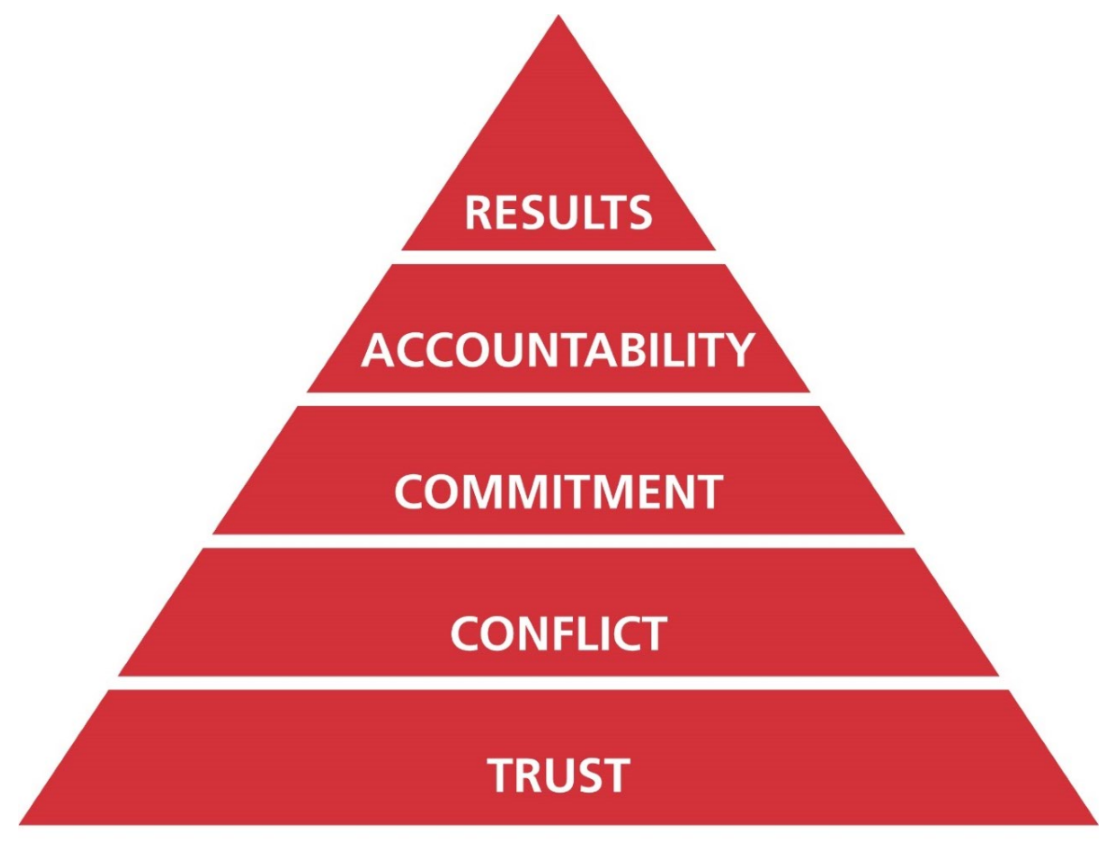
At its core, the model identifies five interdependent behaviours that form the foundation of a high-performing team:
- Trust — Building vulnerability-based trust, where team members feel safe to be open about their mistakes, weaknesses, and challenges.
- Conflict — Engaging in healthy, unfiltered debate around ideas to achieve the best possible outcomes.
- Commitment — Gaining genuine buy-in and clarity around decisions, even when there’s initial disagreement.
- Accountability — Holding one another to high standards and shared commitments without relying solely on the leader.
- Results — Focusing collectively on shared outcomes, rather than individual agendas or departmental silos.
When these five behaviours are intentionally developed and embedded, they transform not only how teams work together — but who they become together.
Why The Five Behaviours® Works
I use many different frameworks in my team coaching, however, what I love about this model is its simplicity and depth. It doesn’t just teach team members what to do — it helps them experience what great teamwork feels like.
The Five Behaviours® Powered by Everything DiSC® takes this a step further by combining Lencioni’s powerful team model with the insights of the Everything DiSC® assessment. This integration allows each team member to understand their own behavioural style — and how it interacts with others.
Team members understand not just what behaviours matter, but how their individual style affects team dynamics. The naturally dominant leader learns how their style might shut down conflict. The naturally cautious analyst understands how they can contribute to accountability conversations. The relationship-focused team builder recognises their role in building vulnerability-based trust.
This self-awareness, combined with understanding of others’ styles, creates a common language for the team. Instead of personality clashes, there’s appreciation for how different styles bring complementary value to each of the five behaviours.
This is where transformation happens. When leaders understand not only the framework but also themselves and each other through a DiSC lens, communication improves, empathy increases, and collaboration deepens.
Teams begin to move from surface-level alignment to true psychological safety, mutual accountability, and shared ownership.
Tangible Benefits
When leadership teams engage with The Five Behaviours® framework, the impact can often extend far beyond the team itself:
Faster, Better Decisions: With trust and healthy conflict, teams can make decisions more quickly and with greater confidence, reducing the costly delays that plague many organisations.
Reduced Politics and Silos: When the team commits to collective results and holds each other accountable, departmental empire-building diminishes.
Improved Execution: Clarity of commitment and peer accountability mean decisions actually get implemented rather than dying in the gap between meeting room and action.
Cultural Impact: The senior team’s behaviours cascade through the organisation. When leaders model vulnerability, healthy debate, commitment, and accountability, these norms spread to teams throughout the company.
Sustainable Performance: Perhaps most importantly, teams built on these five behaviours are resilient. They can navigate market changes, internal challenges, and the inevitable conflicts that arise in growing organisations.
Why It’s So Relevant Today
In an era of rapid change, hybrid work, and increasing complexity, teams can’t afford to operate in silos or rely on top-down communication.
The Five Behaviours® framework gives leaders a shared language and practical roadmap for building cultures of trust, collaboration, and accountability — the very foundations of agility and resilience.
It helps leadership teams re-write the rules of teamwork, equipping them with the mindset and tools to thrive in complexity and uncertainty.
A Premier Learning Solution for Team Effectiveness
With a mission to deliver a premier learning solution that improves team effectiveness and productivity through the understanding and application of The Five Behaviours — Trust, Conflict, Commitment, Accountability, and Results — my Five Behaviours of a Cohesive Team Programme helps to build a culture of high-performing teams through better communication and collaboration.
In Summary: The Benefits of The Five Behaviours® Programme
✅ Builds vulnerability-based trust
✅ Encourages healthy conflict and open dialogue
✅ Creates alignment and commitment around key decisions
✅ Strengthens accountability within the team
✅ Drives collective focus on measurable results
✅ Enhances communication through Everything DiSC® insights
✅ Improves overall team effectiveness, cohesion, and culture
Moving Forward
If you’re working with a leadership team that’s struggling to perform at the level its individual talent suggests it should, I encourage you to examine which of these five behaviours might be the constraint.
In my experience, the challenge is rarely all five. Often, there’s one behaviour—typically trust or accountability—that’s the bottleneck preventing the others from developing. The Five Behaviours® framework provides both a diagnostic lens and a practical roadmap for improvement.
The teams that commit to this work—that engage honestly with where they are and do the sometimes uncomfortable work of building these behaviours—don’t just become more effective teams. They become the kind of teams their people want to be part of, the kind that attract exceptional talent, and the kind that build enduring organisations.
And in the complex, fast-moving environment most leadership teams operate in today, that’s not just nice to have. It’s essential.
Final Reflection
Every high-performing team I’ve worked with shares one thing in common: they’ve done the inner work together.
The Five Behaviours® model gives teams the structure, language, and insight to do just that — to build the trust, clarity, and accountability that unlock their full potential.
If you’re ready to elevate your senior leadership team’s performance and culture, The Five Behaviours® is one of the most effective, evidence-based, and transformational pathways you can take.